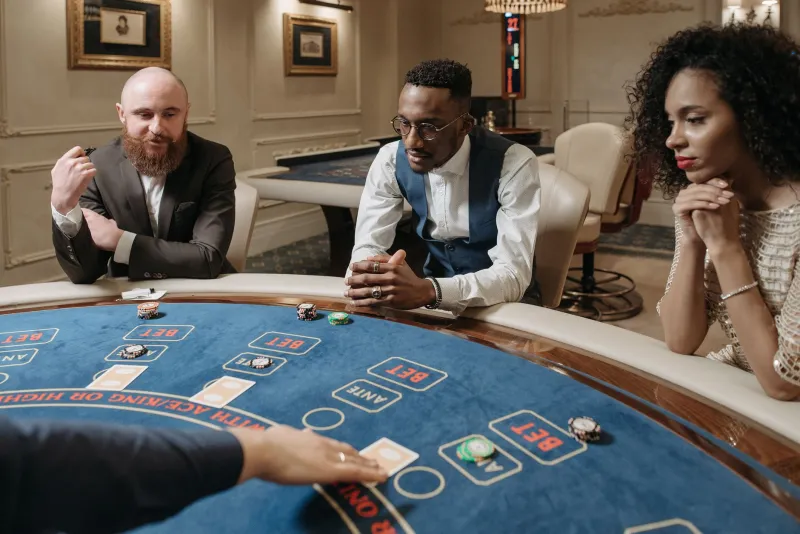
The Invisible Lever: How Mastery of Casino Protocol Gives Australia's Elite Players a Quiet Psychological Edge

There is a particular kind of power that announces itself without announcement. It does not arrive with bravado or ostentatious display. It settles into a room the way quality tailoring settles onto a frame — quietly, completely, and with an authority that requires no explanation. At the premium tables of Australia's finest gaming establishments, this power has a name, though few speak it aloud. It is called etiquette.
For the uninitiated, casino etiquette might appear to be little more than a set of courtesies — the social equivalent of table manners, pleasant but ultimately inconsequential. For Australia's most sophisticated players, however, the unwritten protocols of high-stakes gaming constitute something far more strategic: a sophisticated instrument for shaping table dynamics, managing interpersonal relationships, and establishing psychological positioning before a single significant decision is made.
Protocol as Architecture
Every casino table operates within an invisible social structure. There is a hierarchy of attention, a rhythm of interaction, and a set of expectations — some codified, most unspoken — that govern the flow of play. Elite players do not merely observe this structure. They understand it deeply enough to work within it, and occasionally, to reshape it.
Consider something as elementary as the timing of a chip placement. A novice places chips reactively, following the dealer's cue with visible uncertainty. An experienced player places chips with a deliberate calm — neither rushed nor theatrical — that communicates ease without effort. Dealers, who spend more hours at high-stakes tables than almost anyone, consistently note that this single gesture shifts the entire atmospheric register of a session. It signals to everyone present that this is a player who belongs, and belonging confers an immediate, if intangible, authority.
Similarly, the manner in which a player addresses a dealer — formal without being stiff, warm without being familiar — establishes relational tone with precision. In Australia's premium gaming venues, where discretion and professionalism are currency, a player who demonstrates genuine respect for the dealer's craft tends to receive service of a calibre that others simply do not access. This is not favouritism. It is the natural reciprocity of refined social intelligence.
The Strategic Use of Silence
Perhaps the most underappreciated tool in the elite player's repertoire is silence — specifically, the strategic deployment of it. Conversation at a high-stakes table is not merely social lubricant. It is information, and like all information, it can be given, withheld, or redirected with deliberate intent.
A player who speaks only when speech adds value — who refrains from commentary on others' decisions, who does not fill every pause with nervous chatter — creates a presence that others at the table cannot quite read. This ambiguity is, in itself, an advantage. It is far easier to calibrate one's behaviour toward someone who is transparent than toward someone who is composed and measured. Elite players cultivate this quality with the same discipline they bring to their wagering strategy.
High-stakes observers in venues across Melbourne and Sydney have noted that the players who command the most instinctive respect at the table are rarely the loudest. They are, almost invariably, the quietest — and the most precisely articulate when they do choose to speak.
Gesture, Timing, and the Grammar of Presence
Beyond speech, the physical grammar of casino presence carries enormous communicative weight. The way a player handles chips — with familiarity but without affectation — signals experience. The angle at which a player leans back from the table during a pause communicates either contemplation or disengagement, and the distinction matters. Even the pace at which a player accepts or declines an offered beverage can subtly alter the perception others hold of their confidence and composure.
These are not performances, at least not in the theatrical sense. They are, rather, the natural expressions of deeply internalised understanding. A player who has spent years at premium tables does not consciously calculate each gesture. The protocol has become instinct, and instinct at this level reads, to those around the table, as authority.
This is a distinction that professional dealers frequently articulate: the difference between a player who knows the rules and a player who has absorbed them. The former is technically correct. The latter is, as one senior baccarat dealer in a leading Melbourne establishment once observed, simply different — in the way that a conversation with someone genuinely at ease differs from a conversation with someone performing ease.
Managing the Social Ecosystem
At a multi-player table, the social dynamics are rarely static. Tensions emerge, rhythms shift, and the collective atmosphere of a session can oscillate considerably across the course of an evening. Elite players do not merely react to these fluctuations. They understand how to gently moderate them.
A well-timed acknowledgement of another player's strong hand — neither excessive nor perfunctory — can defuse competitive tension and reorient the table toward a more collaborative register. A quiet word to a dealer during a natural break, offered with genuine courtesy rather than calculation, can reset the interpersonal tone of an entire session. These micro-interventions require no grand gestures. They require only attentiveness and the social intelligence to act on what is observed.
In this sense, the elite player functions less like a solitary strategist and more like a conductor — attuned to every instrument in the room, and capable of influencing the ensemble without drawing attention to the act of influence.
Etiquette as Competitive Distinction
It is worth noting that the advantages derived from mastery of protocol are not merely psychological. They are, in practical terms, structural. Players who demonstrate consistent adherence to the highest standards of casino etiquette tend to receive preferential treatment across every dimension of the premium gaming experience — from table allocation and limit flexibility to the quality of personalised service they receive throughout a session.
This is not coincidental. Premium casino environments are designed to reward exactly this kind of engagement. The values embedded in refined etiquette — restraint, respect, attentiveness, composure — are the same values that define the culture of elite gaming at its finest. When a player embodies those values authentically, they are not merely following protocol. They are speaking the native language of the environment, fluently and without accent.
For Australia's most accomplished casino players, etiquette is never an afterthought. It is strategy expressed through manner — a quiet, continuous, and remarkably effective lever that shapes every table they grace.